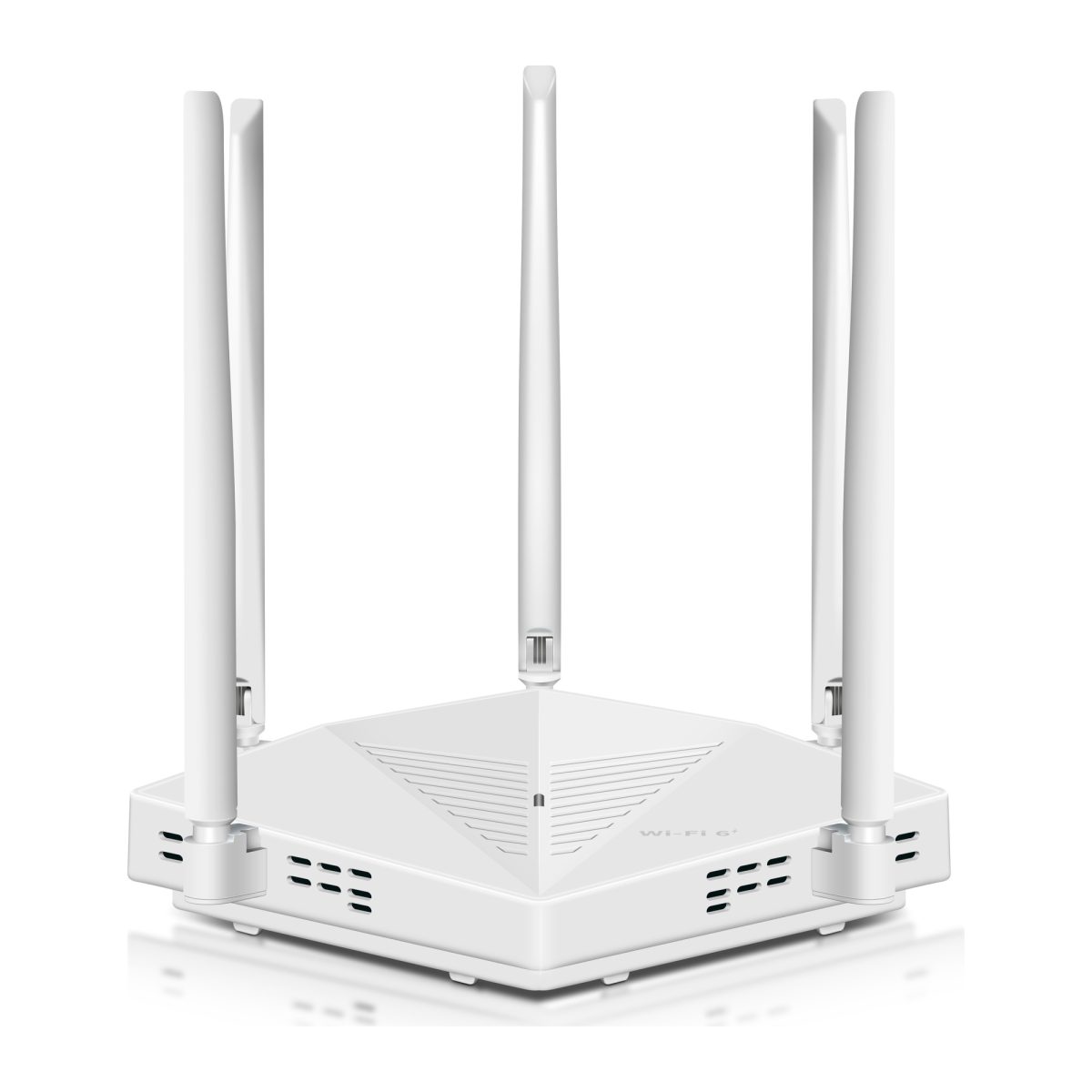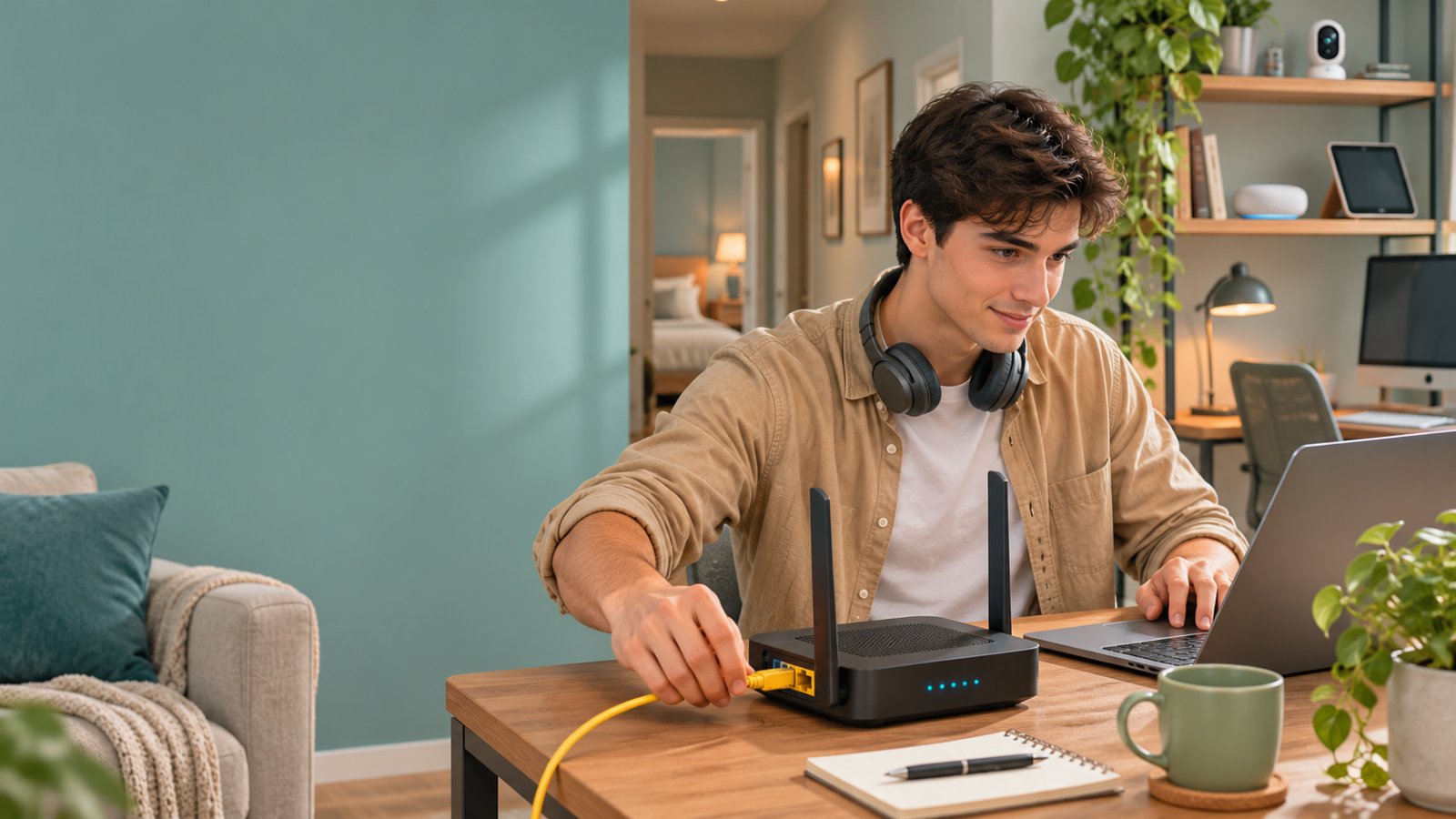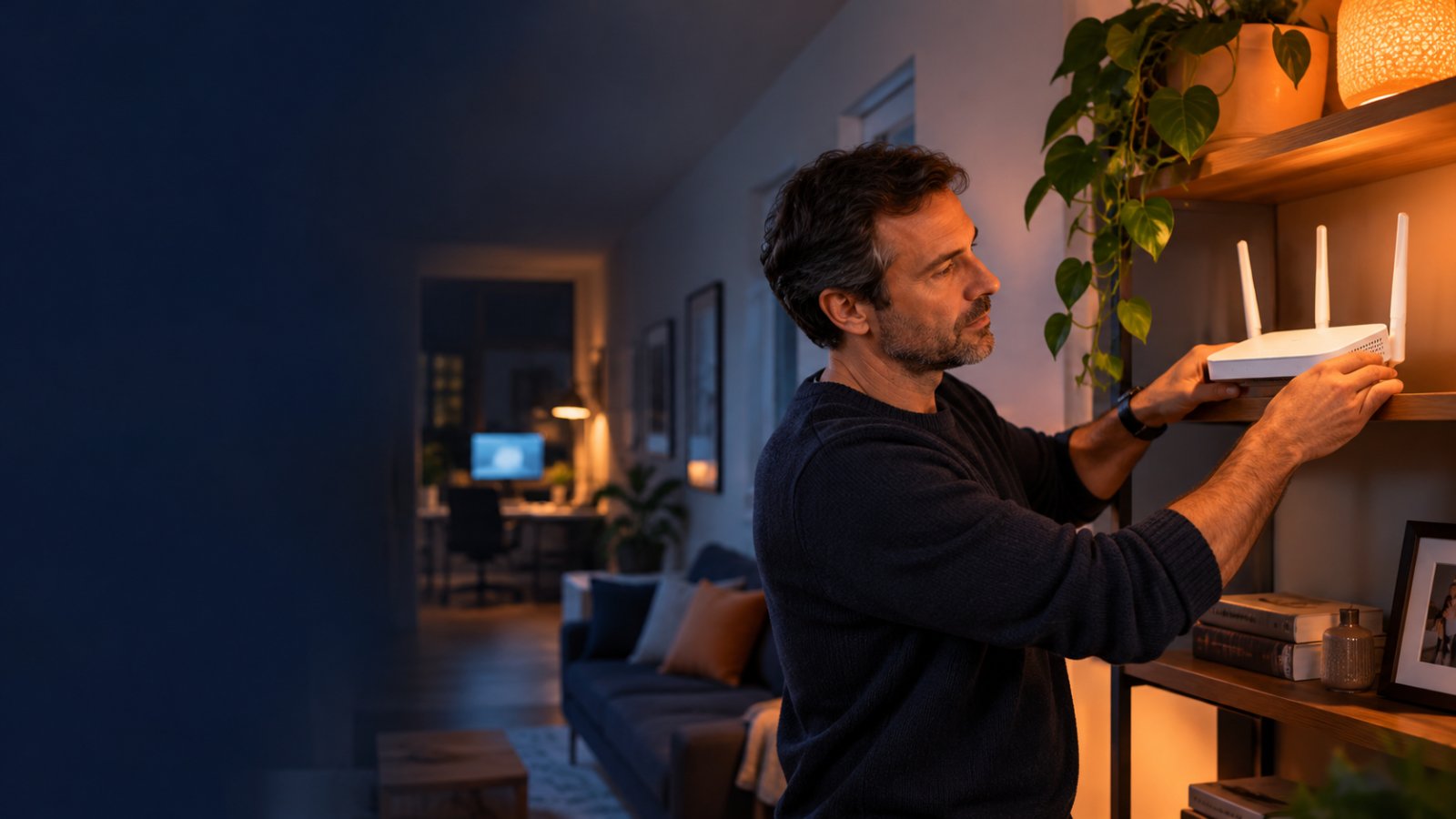
If you are wondering where is the best place to position a wifi router for optimal signal coverage, start with a central, elevated, open location away from thick walls, large metal objects, and major appliances. For many homes, a shelf in the main living area or a central hallway works better than a router tucked behind the television or left beside the front door.
The router's location affects how easily its signal reaches your bedrooms, kitchen, home office, and security cameras. You might have a fast broadband connection but still experience buffering in a back bedroom because the WiFi signal passes through several walls before reaching it.
Before buying a new router or extender, test a few sensible positions. This guide compares seven practical locations, explains what works in different house layouts, and shows you how to measure improvements using devices you already own.
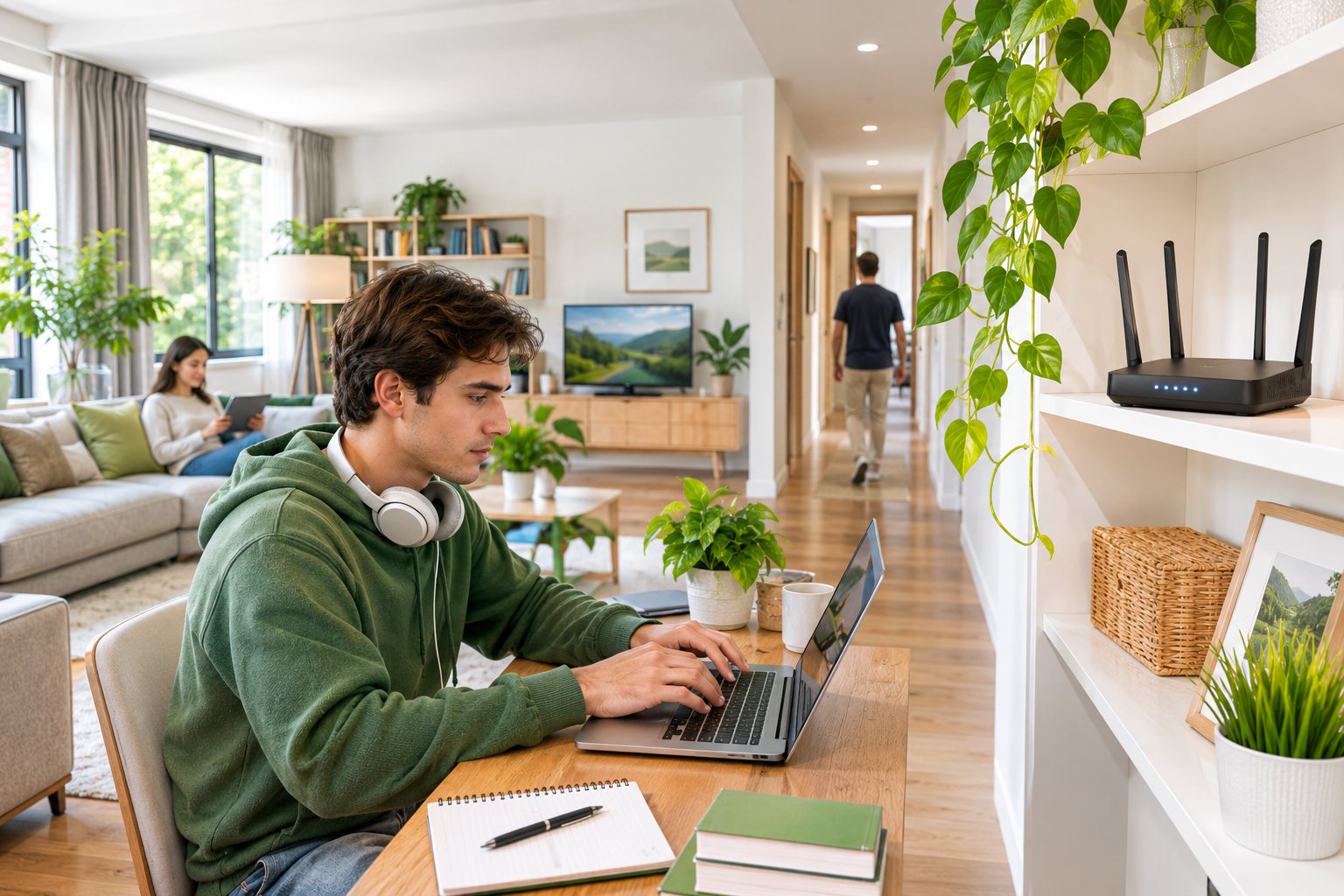
Where Is the Best Place to Position a WiFi Router for Optimal Signal Coverage?
The best router position is usually near the center of the rooms where people actually use WiFi, raised above floor level and kept clear of large obstacles.
Imagine a house with three bedrooms, a living room, a kitchen, and a small office.
If the router sits against the front wall, the signal reaching the rear bedroom may need to pass through the kitchen, a hallway, and two internal walls. A more central location could shorten that wireless path.
But putting the router at the exact center of a floor plan is not always practical.
Perhaps the center of your home is a bathroom or a utility cupboard. Maybe the hallway has reinforced concrete walls, while the adjoining living room is more open.
In that case, an open shelf slightly away from the center may work better.
Choose the location that gives your important rooms the clearest wireless paths, not simply the spot that looks central on paper.
Why Router Placement Changes WiFi Performance
WiFi uses radio signals to communicate between your router and connected devices.
Those signals weaken as they travel. Walls, floors, furniture, metal surfaces, and interference can make the connection less reliable.
Consider a laptop used for video meetings.
When it sits near the router, the connection may remain stable. Move it into a bedroom behind several thick walls, and the picture may freeze even though the internet plan has not changed.
Weak wireless coverage can cause:
-
Slow webpage loading.
-
Buffering during streaming.
-
Frozen video calls.
-
Gaming lag.
-
Frequent disconnections.
-
Unreliable smart home devices.
-
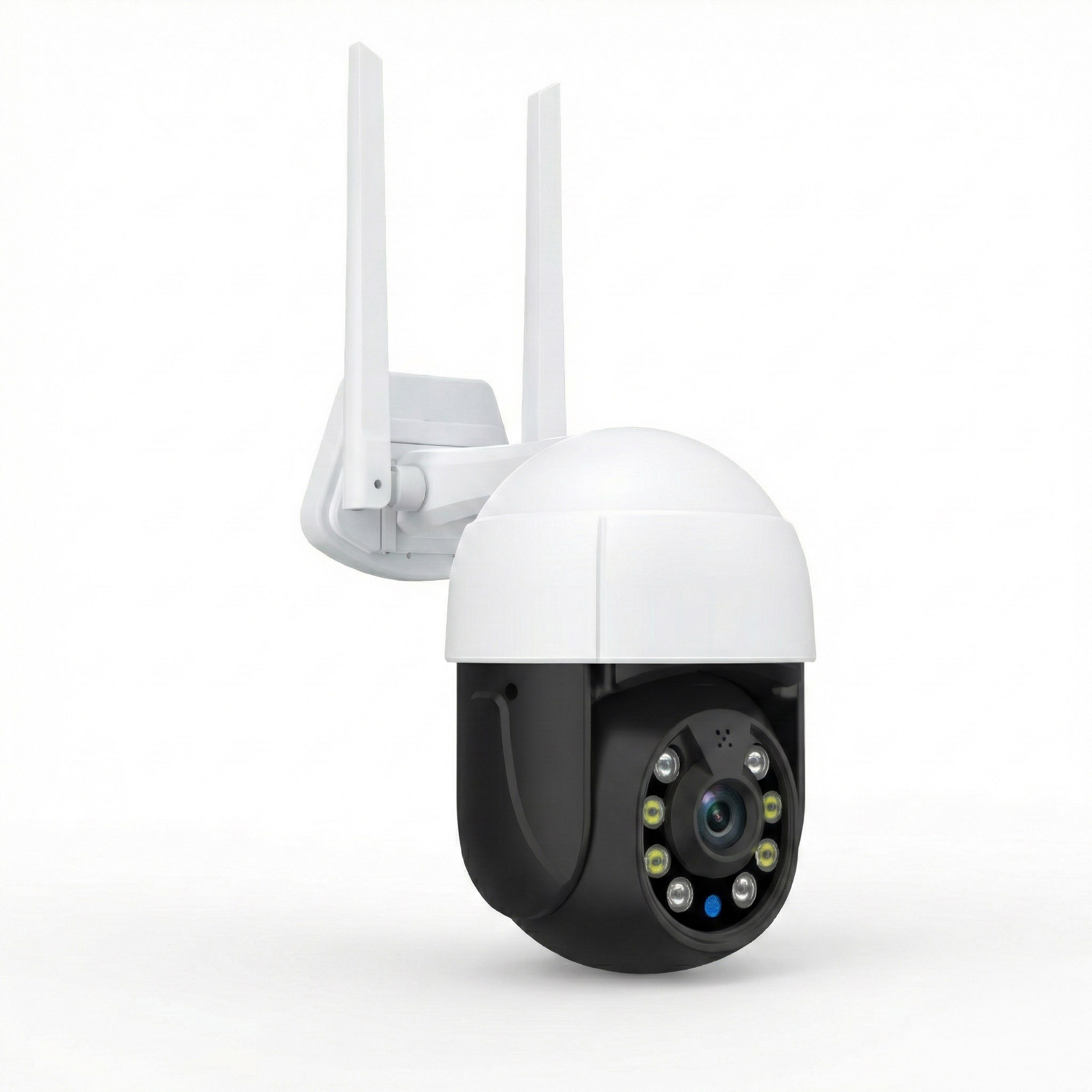
Security cameras dropping offline.
-
Slower file transfers between connected devices.
Your router may have a perfectly good internet connection.
The difficulty is getting that connection through the house.
This is why changing the router's physical location can sometimes produce a more noticeable improvement than adjusting its software settings.
What an Ideal Router Location Looks Like
A suitable location usually has several characteristics:
-
Near the center of the main coverage area.
-
Elevated on a stable shelf or approved mount.
-
Open space around the device.
-
Few large obstacles immediately nearby.
-
Away from metal cabinets and major appliances.
-
Proper ventilation.
-
Access to power and network cabling.
-
A safe position where it will not be knocked over.
-
Reasonably clear paths toward important rooms.
A shelf in an open hallway may satisfy most of these conditions.
A router inside a metal utility cupboard probably will not.
The position should also accommodate your household.
If the router is in a room where children frequently move furniture or pets can pull cables, choose a more secure location.
Good WiFi placement must be practical enough to maintain.
How We Evaluated the Best Router Positions
A router position should be judged by coverage in the rooms that matter, not by the strongest speed test recorded beside the device.
The following criteria help compare locations without relying on invented coverage figures or laboratory results.
Distance to Important Rooms
Start by identifying where WiFi is used most.
A household may depend on wireless connections in the main bedroom, living room, office, and children's study area.
Another may need dependable coverage for a front door camera and a television at the opposite end of the house.
The best router position depends on those demands.
A central location generally reduces the distance to several rooms, but distance is only part of the problem.
A nearby room behind concrete may have a weaker connection than a more distant room reached through an open corridor.
Consider both the distance and what the signal must pass through.
Walls and Physical Obstacles
Building materials affect wireless signals differently.
Ordinary drywall may cause less difficulty than reinforced concrete, dense masonry, or metal-backed construction.
Large mirrors, appliances, and metal shelving can also affect signal propagation.
For example, placing the router directly behind a refrigerator creates an unnecessary obstacle.
Moving it to an open shelf may provide a clearer path into the next room.
The goal is not to remove every object between the router and your devices.
It is to avoid particularly obstructive locations.
Height and Open Space
A router on the floor often sits behind furniture.
A sofa, desk, or cabinet may block part of the wireless path.
Raising the router onto a shelf can help avoid those obstacles.
There is no universal mounting height that works for every model or building.
A stable shelf around chest height is a reasonable starting point for many homes.
Follow the manufacturer's instructions if your router is designed for wall mounting or requires a particular orientation.
Do not block ventilation openings just to achieve a higher position.
Interference From Nearby Devices
Some equipment can interfere with wireless communication.
Potential sources include microwave ovens, certain cordless phones, nearby wireless networks, and devices using the 2.4 GHz band.
Bluetooth equipment also shares portions of that frequency range, although its presence does not necessarily cause a noticeable problem.
You do not need to remove every electronic device from the room.
Simply avoid putting the router directly beside appliances or equipment known to cause interference.
If the connection becomes unreliable whenever a nearby appliance operates, that observation is worth investigating.
Installation Practicality
The router needs electricity and a suitable connection to your internet equipment.
A perfect wireless location is not useful if reaching it requires unsafe cables across the floor.
If your modem and router are separate, a longer Ethernet cable may allow the router to move.
If the internet provider supplied a combined gateway, your choices may be more restricted.
Do not relocate fixed fiber equipment or disconnect unfamiliar service cables without checking the provider's instructions.
Choose a position that improves coverage without creating electrical, ventilation, or trip hazards.
Best Places to Position a WiFi Router in Your Home
These seven locations are worth considering before purchasing additional hardware.
Each has advantages and limitations depending on the layout.
1. A Central Shelf in the Living Area
Best for: Apartments and single-story houses with rooms arranged around a central living space.
A living room can be an effective location when bedrooms, the kitchen, and other spaces connect to it.
For example, a router on an open shelf near the middle of the living room may provide a more balanced connection than one hidden beside the entrance.
Strengths
-
Shorter wireless paths to several rooms.
-
Easy access for troubleshooting.
-
Usually convenient power availability.
-
Simple to reposition during testing.
Limitations
-
Entertainment equipment may obstruct the router.
-
Decorative cabinets can restrict airflow.
-
The living room may be at one end of a long house.
How to position it
Choose an open shelf rather than the space behind the television.
Keep the router clear of stacked devices, metal decorations, and large speakers.
Leave ventilation space.
Test the bedroom, kitchen, and home office afterward.
If one of those rooms becomes noticeably worse, try a nearby shelf rather than assuming the whole living room is unsuitable.
2. An Open Central Hallway
Best for: Homes with bedrooms or living spaces connected by one main corridor.
A central hallway can provide a useful wireless path along the length of the house.
Suppose four bedrooms open onto one corridor.
Placing the router near the middle may reduce the distance and number of obstacles compared with leaving it at one end.
Strengths
-
Relatively direct path toward multiple rooms.
-
Balanced coverage in corridor-style layouts.
-
Fewer large furniture obstacles in some homes.
Limitations
-
Limited outlets.
-
Narrow spaces may make installation awkward.
-
Electrical panels or metal cupboards can interfere with placement.
-
Dense bedroom walls can still weaken reception.
How to position it
Use a secure shelf or manufacturer-approved mount.
Avoid creating a cable hazard in a walkway.
Do not install it directly beside electrical or metal utility enclosures.
Check reception inside the bedrooms.
A strong signal in the hallway alone does not mean coverage is adequate once the room doors are closed.
3. A Secure Wall Mount in an Open Area
Best for: Homes where desks and shelves are crowded or the router is easily knocked over.
Wall mounting can keep a compatible router away from surrounding furniture.
For example, a small office may have monitors, metal shelving, and paperwork occupying every available surface.
A suitable interior wall may offer a cleaner position.
Strengths
-
Keeps the router above many nearby obstacles.
-
Frees usable furniture space.
-
Reduces accidental movement.
-
Can provide a tidy installation.
Limitations
-
Some routers do not support wall mounting.
-
Installation may require drilling.
-
Poor mounting can interfere with ventilation or cable access.
-
An exterior wall may not be ideal for whole-home coverage.
How to position it
Follow the router manufacturer's mounting instructions.
Prefer a central interior wall where practical.
Keep ventilation openings unobstructed.
Before drilling, test the intended location using a temporary stable position if possible.
Renters should consider removable placement options that do not damage the property.
4. An Open Shelf Near the Home Office
Best for: Homes where stable work connectivity is the highest priority.
A home office may be used for video meetings, remote desktops, and file transfers throughout the day.
If that room consistently has weak WiFi, moving the router closer may help.
Strengths
-
Prioritizes an important work area.
-
May reduce walls between the router and the laptop.
-
Convenient for connecting stationary computers through Ethernet.
Limitations
-
Coverage may become uneven.
-
A corner office can leave distant rooms underserved.
-
Monitors and metal furniture may create obstacles.
How to position it
Keep the router away from the back of monitors and computer cases.
Use an open shelf.
Test video calls and normal work applications, not just speed.
Then check the bedrooms and living room.
If the office improves but everyone else loses reliable WiFi, a wired connection for the office computer or an additional access point may be a better solution.
5. A Central Position Near the Staircase
Best for: Two-story homes with an open staircase or landing connecting the floors.
An open stairwell can sometimes provide a useful path between levels.
For example, a router near a central staircase may reach upstairs rooms more effectively than one placed in a distant downstairs corner.
Strengths
-
May improve wireless paths between floors.
-
Can provide a central location in certain layouts.
-
Useful when rooms open toward the landing.
Limitations
-
Reinforced concrete floors may still block much of the signal.
-
Metal railings can affect the surrounding wireless environment.
-
Suitable outlets and mounting positions may be limited.
How to position it
Choose a safe, open position near the staircase.
Avoid large metal obstructions where possible.
Test upstairs and downstairs separately.
Do not rely on a strong connection at the landing while ignoring the bedrooms behind closed doors.
If the upstairs rooms remain weak, an additional wired access point or mesh node may be more useful than repeated router moves.
6. A Slightly Off-Center Location Near the Main Devices
Best for: Homes where most internet activity happens in one section.
The exact center is not always where coverage matters most.
Imagine a long house with the main bedrooms, living room, and office near the front.
The rear contains a storage room and an occasional-use guest room.
Positioning the router slightly toward the occupied rooms may be sensible.
Strengths
-
Prioritizes everyday usage.
-
Can improve the most important connections.
-
May avoid unsuitable central mounting locations.
Limitations
-
Distant rooms may receive weaker coverage.
-
Outdoor cameras may be affected.
-
A future change in room use can alter the requirements.
How to position it
Identify your highest-priority devices.
Include laptops, televisions, phones, smart home equipment, and security cameras.
Choose the position that serves those devices with reasonable reliability.
Check the opposite end of the house before settling on it.
A slight improvement to one laptop is not worth disconnecting a security camera that needs continuous network access.
7. Near the Existing Internet Connection, With Better Clearance
Best for: Renters and households with fixed internet installations.
Sometimes the router cannot move far from the modem or gateway.
Even so, the current position may be unnecessarily poor.
For example, the internet equipment may sit beside the front wall, hidden behind a television stand.
Moving it onto an open shelf within cable reach can remove several obstacles.
Strengths
-
Minimal changes to the existing installation.
-
Often no additional equipment required.
-
Suitable for rentals.
-
Easy to reverse.
Limitations
-
The router may remain far from some rooms.
-
Cable length restricts options.
-
Exterior wall placement may remain less effective.
How to position it
Move the router out of cabinets and off the floor.
Keep the device ventilated.
Organize the cables.
If the router and modem are separate, a suitable Ethernet cable may provide more placement freedom.
If you have a combined provider gateway, confirm which changes are allowed.
Router Placement Comparison Table
| Location | Best Situation | Main Advantage | Main Limitation |
|---|---|---|---|
| Central living area shelf | Apartments and compact houses | Balanced coverage | Nearby entertainment equipment |
| Central hallway | Corridor-style homes | Clearer paths toward several rooms | Limited mounting options |
| Interior wall mount | Cluttered rooms | Elevated and secure | Installation requirements |
| Home office shelf | Remote work priority | Better coverage near work devices | Distant rooms may suffer |
| Staircase or landing | Multi-floor homes | Potential path between floors | Thick floors remain obstacles |
| Slightly off-center location | Devices concentrated in one area | Prioritizes everyday use | Uneven whole-home coverage |
| Near existing gateway | Rentals and fixed installations | Simple, low-cost improvement | Limited relocation distance |
Best overall starting point: A central, open, elevated position with reasonable wireless paths toward the rooms that matter most.
There is no need to choose a permanent location before testing.
Where You Should Never Put a WiFi Router
Certain locations create problems that are often avoidable.
Check these before changing wireless channels or buying new equipment.
Inside a Closed Cabinet
A closed cabinet can obstruct wireless signals and restrict airflow.
The problem can be worse with metal doors or tightly packed electronics.
If your router currently sits in a television cabinet, take it out temporarily and test the connection in the problem room.
Keep it on a stable, ventilated surface.
You may discover that the cabinet is contributing to the weak connection.
Directly on the Floor
Floor placement often puts the router behind furniture.
It can also leave cables exposed to pets or accidental movement.
Move the router onto a shelf.
Keep ventilation openings clear.
Avoid thick carpet or fabric underneath the device.
You do not need to mount it near the ceiling to gain the benefit of removing floor-level obstacles.
Behind a Large Television
Televisions contain metal components and other materials that can affect the nearby radio environment.
A router pressed against the back of the screen is unnecessarily obstructed.
Move it to an open shelf beside the entertainment area.
Leave space between the router and other equipment.
Test the distant rooms afterward.
Next to a Microwave Oven
Microwave ovens operate at frequencies near the 2.4 GHz WiFi band.
They can cause interference in some circumstances, especially while running.
Avoid locating the router directly beside one.
If your connection becomes unstable whenever the microwave operates, test a position farther away.
Do not assume every kitchen appliance is causing interference.
Check whether the problem is repeatable.
Beside a Refrigerator or Large Metal Cabinet
Large metal objects can block or reflect radio signals.
A refrigerator or filing cabinet can create an unnecessary obstacle.
Avoid positioning the router behind such equipment.
A nearby open shelf is usually a better starting point.
Near Direct Sunlight or Strong Heat
Routers generate heat during operation.
Direct sunlight, heating appliances, and poorly ventilated spaces can make cooling more difficult.
Follow the manufacturer's operating temperature guidance.
Do not cover the device or stack equipment on top of it.
A position that looks tidy but traps heat is not a suitable long-term installation.
In a Basement Corner
A basement router may struggle to reach upstairs rooms through thick floors.
If the internet connection enters through the basement, consider whether the router can be connected to a more central location using Ethernet.
Another option is keeping the main networking equipment downstairs and installing a wired access point upstairs.
Do not assume one powerful router will overcome reinforced construction.
Beside an Exterior Wall
An exterior wall may be where the broadband cable enters.
It may also leave the router far from the opposite side of the home.
Moving it inward can reduce the wireless distance to important rooms.
If the gateway cannot move, consider whether a separate wireless access point can be placed more centrally.
How WiFi Frequency Bands Affect Router Position
Router placement affects different WiFi frequency bands in different ways.
Understanding the basics helps explain why a smart camera remains connected while a laptop struggles in the same part of the house.
2.4 GHz WiFi for Greater Reach
The 2.4 GHz band often reaches farther through common household obstacles than higher-frequency bands.
It is widely used by smart plugs, cameras, and other connected devices.
However, it can also experience congestion from nearby networks and other equipment.
For example, an outdoor camera may maintain its 2.4 GHz connection through an exterior wall while a nearby laptop's 5 GHz connection becomes weak.
That does not mean the camera's connection is necessarily fast or stable enough.
Test the actual live view or device function.
5 GHz WiFi for Faster Nearby Connections
The 5 GHz band can support higher throughput under suitable conditions.
It is often useful for laptops, televisions, and other devices that benefit from stronger wireless performance.
However, walls and distance can weaken it more significantly.
A laptop may perform well near the router but struggle in a bedroom separated by several walls.
Better router placement can help reduce those obstacles.
For a large house, additional access points may still be necessary.
What About 6 GHz?
Some WiFi 6E and WiFi 7 routers support 6 GHz.
This band provides additional wireless spectrum for compatible devices.
However, it generally has more difficulty reaching distant rooms through obstacles than lower-frequency WiFi.
A new router with 6 GHz support will not automatically solve coverage problems caused by concrete walls.
You still need suitable placement and, where necessary, additional coverage equipment.
Does Changing the Band Fix Poor Router Placement?
Sometimes a device may connect more reliably using another supported band.
For example, a distant smart home device may work better on 2.4 GHz.
But changing bands does not remove physical obstacles.
A router hidden behind a refrigerator remains poorly positioned.
Correct obvious location problems first.
Then investigate band selection and other wireless settings if needed.
How to Test the Best WiFi Position Before Moving Everything
You can compare router locations using a phone or laptop.
The key is testing the same rooms under reasonably similar conditions.
Step 1: Record Your Current Router Location
Take note of where the router sits.
Check whether it is:
-
On the floor.
-
Inside furniture.
-
Beside a large appliance.
-
Near an exterior wall.
-
At one end of the house.
-
Behind a television.
-
Surrounded by cables and other electronics.
Identify the rooms where WiFi regularly fails.
Write down the specific problem.
For example, the bedroom video call freezes, the back camera disconnects, or streaming buffers in the kitchen.
These observations will help you judge whether moving the router worked.
Step 2: Test WiFi Near the Router
Connect a phone or laptop to the home network.
Stand near the router.
Open a few normal websites and run a speed test from a trusted service.
Repeat the test if results fluctuate.
Avoid testing while someone else is downloading a large file or backing up several devices.
If performance is already poor near the router, placement may not be the main issue.
Check the broadband connection.
If possible, compare with an Ethernet-connected computer.
Good wired performance combined with poor wireless performance points toward a local WiFi issue.
Step 3: Visit the Rooms That Matter Most
Use the same device in each room.
Check:
-
Whether the connection stays active.
-
Whether websites load normally.
-
Whether a video call is stable.
-
Whether streaming buffers.
-
Whether the signal changes near particular walls.
-
Whether the device frequently reconnects.
Record the result in plain language.
For example:
-
Living room: Reliable.
-
Main bedroom: Reliable.
-
Office: Video calls occasionally freeze.
-
Kitchen: Connection drops near the rear wall.
-
Back bedroom: Slow and inconsistent.
-
Outdoor camera: Sometimes offline.
This is more useful than relying on a single speed result.
Step 4: Choose One Better Position
Select one candidate location.
For example, move the router from behind the television to an open shelf nearer the middle of the house.
Keep the other settings unchanged.
Do not simultaneously change the WiFi name, channel, frequency settings, and physical position.
You need to know which change affected the connection.
Make sure the router remains safely connected and ventilated.
Step 5: Repeat the Same Tests
Use the same phone or laptop.
Visit the same rooms.
Try the same activities.
Pay attention to whether the original problem has improved.
If the office video call becomes stable, that is useful.
But also check the bedroom that previously worked well.
Moving the router can improve one area while weakening another.
Choose the position that gives the best overall result for your household.
Step 6: Check Important Smart Devices
Fixed smart home equipment can be easy to overlook.
After moving the router, test:
-
Smart televisions.
-
Wireless printers.
-
Video doorbells.
-
Outdoor security cameras.
-
Smart speakers.
-
Smart plugs.
-
Other connected home devices.
Check their actual functions.
For a security camera, open the live view and confirm that it connects normally.
For a printer, send a test print.
For a smart plug, check whether it responds to a normal command.
A stronger phone connection does not guarantee every fixed device benefits from the move.
Step 7: Keep the Better Location
Once a position works well, secure the router.
Organize the cables.
Keep ventilation space.
If wall mounting is needed, confirm that the tested position can be reproduced safely.
If several rooms remain weak, do not keep moving the router indefinitely.
The property may need an additional wireless access point or another suitable coverage solution.
How to Choose the Best Router Position by Home Layout
The layout affects how far signals must travel and which obstacles they encounter.
Choose your first test location based on the building rather than copying another homeowner's exact setup.
Small Apartment
A central shelf in the living area is often enough.
Avoid hiding the router behind the television.
If the internet enters near the front door, move the router inward where practical.
Check the bedroom and work desk.
In apartment buildings, neighboring WiFi networks may also contribute to congestion.
Placement remains the first thing to check when your router is obviously obstructed.
Single-Story House
Look for an open hallway or central living space.
Identify the rooms at opposite ends of the house.
If the router sits beside the front door, try moving it toward the middle.
Dense interior walls may still cause weak spots.
Test the farthest bedrooms and any outdoor cameras.
A long house may need another access point even after the main router is well positioned.
Two-Story House
A central stairwell or landing may provide a useful starting location.
But reinforced floors can weaken WiFi significantly.
Test both floors independently.
If upstairs bedrooms remain unreliable, investigate a compatible additional access point or mesh node.
Do not assume that a router providing a strong connection on the staircase will work equally well through several bedroom walls.
Large Villa or Spread-Out Property
A large villa may include long corridors, separate wings, multiple floors, and outdoor areas.
One router may not cover every important location.
Choose a suitable central position for the main equipment.
Then identify remaining coverage gaps.
Wired access points or a properly designed mesh arrangement may be needed.
If Ethernet cabling already runs between rooms, take advantage of it.
A wired connection between access points can avoid relying on a weak wireless link through distant walls.
Home With Thick Concrete Walls
Dense concrete can weaken wireless signals substantially.
Try placing the router where it has fewer walls between itself and the main devices.
An open corridor may work better than an enclosed corner room.
However, placement can only do so much.
A wired access point on the other side of a difficult wall may provide a more dependable solution.
A repeater placed inside the dead zone cannot create a strong connection from a weak incoming signal.
Rental Home With a Fixed Gateway
Start with changes that do not require drilling or relocating the internet connection.
Move the gateway onto an open shelf.
Remove surrounding clutter.
Keep cables safely arranged.
If the internet provider's equipment cannot be moved, a compatible extender or additional access point may help in certain layouts.
Check the equipment and lease restrictions before making permanent changes.
Router Antenna Position: Does It Matter?
Some routers have adjustable external antennas.
Others use antennas inside the casing.
Antenna orientation can influence wireless performance, but there is no universal angle that suits every model.
Routers With External Antennas
Follow the manufacturer's recommendations.
For some compatible designs, keeping antennas vertical is a reasonable starting arrangement for same-floor coverage.
Other designs may benefit from different orientations, especially in multi-floor environments.
Do not assume that pointing every antenna directly at the room you want to reach will improve the connection.
Wireless antenna patterns are more complicated than a narrow beam from a flashlight.
Test any adjustment in the affected rooms.
Routers With Internal Antennas
Routers with internal antennas are generally intended to operate in a particular orientation.
Use the position specified by the manufacturer.
Do not turn the router sideways merely because it fits behind furniture.
That may also interfere with ventilation.
Keep the device open and unobstructed.
Can Antenna Adjustments Replace Better Placement?
Usually not.
Adjusting antenna orientation may help with some coverage problems.
But it will not remove a concrete wall or a metal cabinet from the wireless path.
Fix the router's position first.
Then experiment with antenna settings if your model supports them.
Common Router Placement Mistakes and How to Fix Them
Several common mistakes can be corrected without replacing equipment.
Choosing the Location Closest to the Internet Cable
The broadband entry point may be in a garage, utility cupboard, or front corner.
That is convenient for installation, not necessarily for WiFi.
If the modem and router are separate, consider moving the router using a suitable Ethernet connection.
If you have a combined gateway, check the provider's options.
Avoid relocating fixed fiber equipment without appropriate guidance.
Hiding the Router for Appearance
An enclosed cabinet may keep networking equipment out of sight, but it can obstruct WiFi and trap heat.
Use an open shelf.
Organize cables to keep the area tidy.
Do not stack books, decorative items, or other electronics directly against the router.
Placing the Router Near Large Appliances
Refrigerators, microwave ovens, and other large appliances can create unnecessary obstacles or interference.
Move the router to a nearby open position.
If interference is suspected, test whether the connection changes when the appliance is operating.
Avoid assuming every slowdown is caused by a nearby device.
Moving the Router Without Testing Other Rooms
Improving the office connection while disconnecting the doorbell camera is not a successful whole-home adjustment.
Test the important rooms and fixed devices after every significant move.
Keep a simple record.
A location that balances several important connections may be better than one that produces the fastest result in a single room.
Buying a New Router Before Checking Placement
A newer router may offer better features, capacity, and security support.
But it cannot guarantee coverage through every wall.
If the existing device works well nearby and fails only in distant rooms, investigate placement and additional access points first.
Do not spend money on a replacement without identifying the actual problem.
Confusing Internet Speed With WiFi Coverage
A slow broadband connection and weak WiFi are different problems.
If a wired computer is also slow, contact the provider or troubleshoot the internet connection.
If wired performance is good but distant WiFi devices struggle, focus on wireless coverage.
Upgrading the broadband plan will not automatically improve a weak radio signal.
When Better Router Placement Is Not Enough
Sometimes the building is too large or obstructed for a single router to cover reliably.
That is when additional equipment becomes worth considering.
When to Consider a WiFi Extender
A WiFi extender can help when the router covers most rooms but one area remains weak.
For example, the living room, kitchen, and bedrooms may work well except for a rear study.
An extender can receive the existing WiFi signal and retransmit it toward that room.
Place it where the original signal is still usable, not at the far end of the dead zone.
The extender needs a dependable connection back to the router.
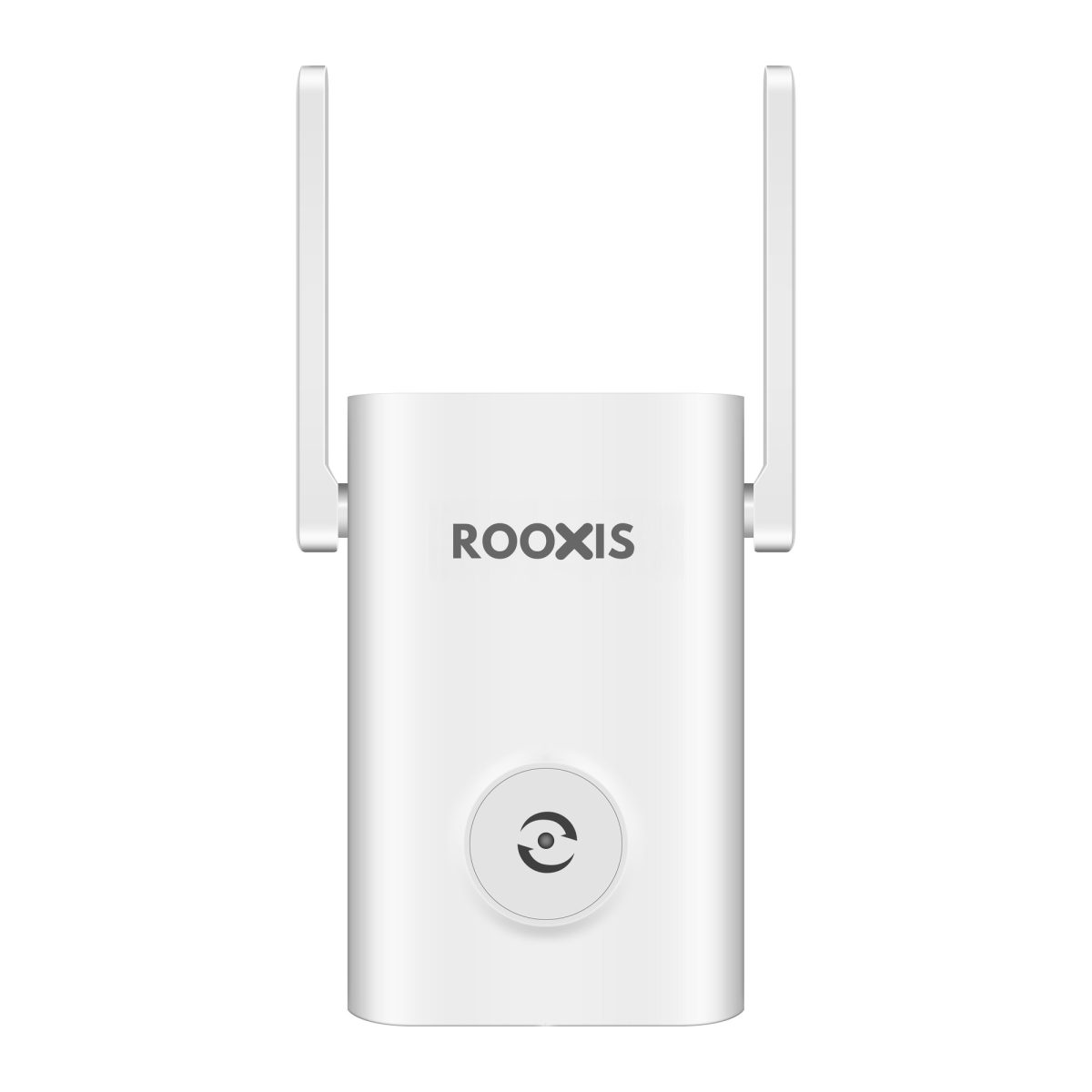
ROOXIS provides routers and range extenders for different home networking needs. The ROOXIS networking products include options worth comparing when repositioning the main router is not enough.
Check the device's supported standards, setup modes, and installation requirements before choosing one.
When to Consider Mesh WiFi
Mesh systems may help when several areas have unreliable coverage.
Compatible nodes work together to extend the network across a larger property.
However, mesh equipment still needs a reliable connection between nodes.
A node placed too far away may provide disappointing results.
Where available, wired backhaul can be useful for difficult layouts.
Do not assume a mesh system eliminates the need for thoughtful placement.
When to Consider a Wired Access Point
A wired access point connects to the network through Ethernet and provides WiFi from another location.
This can be effective where dense walls or floors make wireless repeating unreliable.
For example, a home may have Ethernet wiring to an upstairs study.
A suitable access point installed there can serve nearby rooms without depending on a weak wireless link through concrete.
Check compatibility with the existing network.
If installation involves wall wiring, use appropriate professional assistance when necessary.
When to Replace the Main Router
Consider replacement if the router is defective, unsupported, or unreliable even when devices are nearby.
Possible signs include:
-
Unexpected restarts.
-
Repeated failures throughout the house.
-
Lack of available security updates.
-
Persistent connection faults near the router.
-
Hardware problems that remain after basic troubleshooting.
Before replacing it, check firmware updates and the broadband connection.
If the device works normally nearby, a coverage solution may be more appropriate.
When to Contact the Internet Provider
Contact the provider when the underlying service is unreliable.
Examples include:
-
The modem repeatedly loses connectivity.
-
Wired devices are also slow.
-
The connection fails throughout the home.
-
The gateway reports service faults.
-
Internet cabling needs professional relocation.
An extender cannot repair an unstable broadband line.
Resolve service problems before adding more wireless equipment.
A Practical Router Placement Checklist
Use this checklist before deciding that your router needs replacing.
Physical placement
-
The router is near the main coverage area.
-
It is raised above floor level.
-
It is on a stable, open surface.
-
Ventilation openings are clear.
-
It is not behind a television.
-
It is away from major metal obstacles.
-
It is not directly beside a microwave.
-
Power and network cables are safely arranged.
-
The device is protected from strong heat and direct sunlight.
Coverage
-
WiFi works reliably near the router.
-
The living room connection is stable.
-
Important bedrooms have usable coverage.
-
Work calls function normally.
-
Streaming devices remain connected.
-
Smart home equipment responds correctly.
-
Security cameras maintain their expected connection.
-
Moving between rooms does not cause frequent dropouts.
Troubleshooting
-
Router firmware is up to date.
-
The broadband connection itself is stable.
-
Obvious placement problems have been corrected.
-
The same rooms were tested before and after moving the router.
-
The impact on fixed devices has been checked.
-
Remaining dead spots have been identified.
-
Additional equipment is being considered only where needed.
Do not buy a new router merely because one distant bedroom has a weak signal.
First determine whether the issue is placement, construction, interference, or insufficient network coverage.
FAQ
Where Is the Best Place to Position a WiFi Router in a House?
A central, elevated, open location is usually the best starting point. Choose a position with relatively clear paths toward the rooms where WiFi is used most, and avoid cabinets, major appliances, and large metal objects. Test your important rooms because the ideal position depends on the home's construction and layout.
Is It Better to Put a WiFi Router High or Low?
An open shelf above floor level is generally preferable to placing the router on the floor behind furniture. Raising it can reduce nearby obstructions, but mounting it as high as possible is not always necessary. Follow the manufacturer's placement and ventilation instructions.
Should a WiFi Router Be Near a Window?
A window is not automatically an ideal position. A router beside an exterior wall may be farther from the rooms that need coverage, and direct sunlight can create unnecessary heat. For whole-home WiFi, an open interior location is usually a better first option.
What Is the Best Router Position for a Two-Story House?
A central staircase or open landing may provide a useful wireless path between floors. However, thick concrete floors and walls can weaken signals, so one router may not cover every room reliably. Test both levels and consider a wired access point or compatible mesh arrangement if several rooms remain weak.
Can Moving My Router Improve Internet Speed?
Moving a router can improve wireless performance when obstacles or poor positioning weaken the signal. It does not increase the speed delivered by the broadband provider. If the internet connection is slow even through Ethernet, investigate the service rather than focusing only on router placement.
Where Should I Place My Router to Avoid WiFi Dead Spots?
Start with a central, elevated position away from cabinets, appliances, and dense obstacles. Test the rooms where the connection becomes unreliable, then adjust the position to reduce the barriers between the router and those devices. If dead spots remain because of distance or building materials, an extender, mesh system, or wired access point may be needed.
The best router position is the one that provides dependable coverage in the rooms you actually use. For most households, that means an open shelf near the center of the living area, not a floor-level corner beside the broadband connection.
Start by moving the router away from obvious obstacles. Check the office, bedrooms, living room, and fixed smart devices. Compare their performance before and after the change.
If WiFi is strong beside the router but unreliable through several walls, the building may need additional access points rather than a more expensive standalone router.
Before spending money, fix the position, test the rooms, and identify exactly where coverage fails.